Showing posts with label Nevada. Show all posts

Thursday, August 13, 2015

The Vegas Strip

Caesar's Palace
This post is going to be more pictorial than anything, because quite honestly, I don't have a lot to say about the Vegas Strip.

For all of the expected gaudiness, it is actually a very nice area and we spent a couple of afternoons wandering, sightseeing, etc.

In fact, the gardens at Caesar's Palace were a perfect little oasis of peace, a far cry from the constant noise and lights of Fremont.


The Bellagio
We did consider stopping for a cocktail at the Bellagio, but after viewing the prices, stopped off at Sin City Brewing instead for an excellent beer. I'm not at a point in my life where I can justify $30+ for a simple frozen cocktail.

This is really the place to see the incredibly wealthy and the high-end boutiques, as well as the lower end. But I think what surprised me was how family friendly the strip was. It was just a pleasant way to spend an hour or two.

We did take in one show during our trip. Penn and Teller were on a summer break, so instead we took in the Zombie Burlesque at Planet Hollywood. Lots of fun. But even if you're not into shows and casinos (and I definitely am not), do take the time to browse the strip.


The famous fountains at the Bellagio


The gardens at Caesar's Palace


Inside the Bellagio

Tuesday, August 11, 2015

Exploring Vegas - Fremont St.

Fremont St at night
During our recent trip to Vegas, we stayed in the Fremont St area, against the advice of friends who rarely ventured off the strip during their vacations.

Fremont Street is the old downtown area, before the development of what is now the Strip. This is where the first casinos and hotels were all built. For a while, it became the seedy side of town, but it has recently undergone something of a facelift and is now a bustling hive of activity encased in a video screen ceiling which broadcasts concert footage.

In truth it was very much a mix of the good and bad that Las Vegas has to offer. There are still plenty of casinos and restaurants, as well as street entertainment, live bands, and so on. If you're visiting with children, my advice would be to browse during the weekdays or the week evenings. Friday through Sunday is awash with panhandlers, topless women, mankinis, church groups praying for your soul, and people drinking.

Better yet, take the kids to the Container Park. We only discovered this on the last day of our trip and it was all of a block from our hotel.

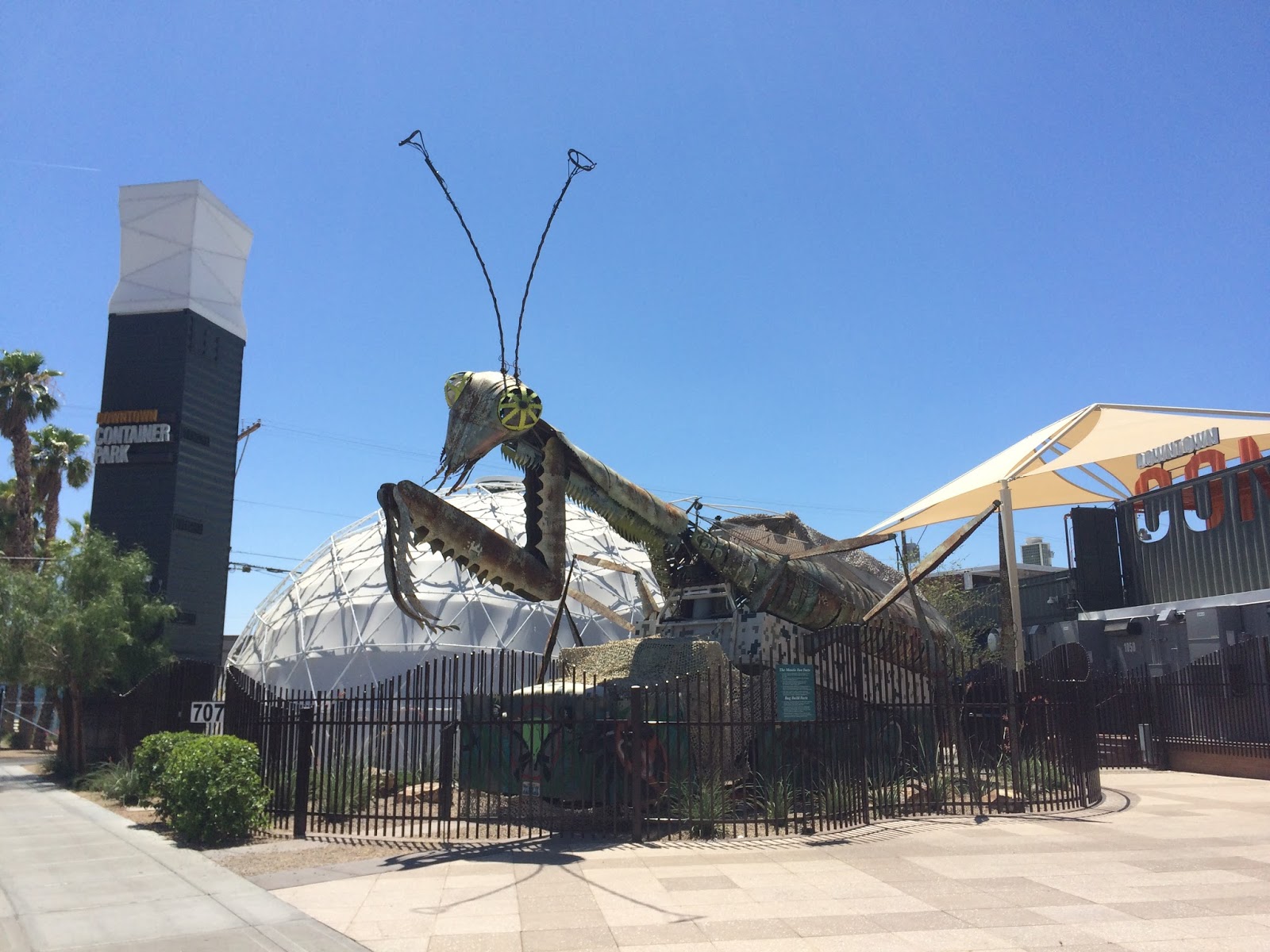
The Container Park is a block or two away from the main Fremont St craziness and is filled with boutiques, restaurants, and entertainment for the whole family. How we missed it, I'm not quite sure; there is a huge praying mantis sculpture at the entrance.

The atmosphere is laid-back and peaceful, a stark difference to the neighboring blocks. Even better for families: there is a large play area for kids. Looking at a posted schedule, it is clear that lots of entertainment is available throughout the summer, from open-air concerts to family movie nights.

Had we discovered this sooner, we would have tried one of the restaurants. Next time....

Another place to make sure you visit in the area is the Mob Museum. You can book tickets online (and save $2 per person by doing so). Housed in the former Las Vegas Post Office and Courthouse, the Mob Museum is three floors of everything you could ever want to know about organized crime and law enforcement attempts to combat it, not just in Sin City but nationwide.

Tours begin on the third floor with the chance to participate in your own police lineup. Learn about the birth of the mob, the origins of Las Vegas, and much more. You can also see the original wall from the infamous St. Valentine's Day Massacre.

Work your way through the exhibits, learning about possible mob connections to the assassination of JFK, trying a Tommy Gun, and seeing some of the more gruesome tools used in a number of murders. Near the end of the tour you get to sit in the courtroom where the Vegas hearings for the Kefauver Committee took place. Watch footage from the hearings before making your way back to the first floor where you'll see exhibits of, among other things, movies and the mob.

In all, be sure to allow 3 hours or so to tour the museum; there truly is that much to see.

All this reading built up an appetite, but where to eat in Fremont Street? Check back tomorrow to find out.

Tuesday, August 4, 2015

Desert Mining Towns Part 2 - Rhyolite, NV

Yesterday, I wrote about the former mining town of Chloride, AZ, now a quirky community with gunfights for tourists at weekends.

Today I want to look at another former mining town that we visited during our trip to Nevada, this one now a skeleton of its former self, and just a few miles from Death Valley National Park. Just as Chloride was named for the mineral mined there, so Rhyolite was a source of its titular mineral, as well as gold and quartz. But I'm getting ahead of myself... first the drive there.

Long, empty road.

To reach Rhyolite, we followed the directions given on the Death Valley NP site, following the long road to Beatty and then turning toward the park. The drive itself was not particularly remarkable, save for the reminders that we were in Nevada, where brothels are legal. My favorite roadside billboard (which sadly I did not take a picture of) proudly advertised: BROTHEL - Hot Sauce, Pictures, Souvenirs. 

Hot sauce - who knew!
The gas station where we stopped also sold a variety of Bunny Ranch souvenirs.

We didn't stop in Beatty, although we later learned that it is home to a huge candy store, one of the biggest in the state, thanks to a local entrepreneur with a sweet tooth. 

On the road from Beatty to Hell's Gate, in one of the most desolate places you can imagine, there is a road that turns off to the remains of Rhyolite, paved in spots, gravel in others. Follow that a little way and turn off to the left toward Bullfrog. One more left turn down a gravel road brings you to the Rhyolite/Bullfrog cemetery (Did you think I'd skip it?) 
Cemetery


The cemetery is home to some 280 graves, although the majority of them are unmarked or marked only by a simple pile of rocks.
A monument marks the historical significance of the site, and there are a few more recent graves.

A few older ones have stone markers, which are still legible. They offer a glimpse into the miners who settled the town, people such as Daniel Kennedy, who traveled from Nova Scotia to

Grave of Daniel Kennedy
Bullfrog, presumably to find his fortune. Daniel died at the tender age of 21.

Other graves, even if once marked, were now worn away to - if lucky - a faded wooden slab, the occupants' names and stories lost to the mists of time.

Rocks outline the two graves marked by this more recent stone.

Some old graves have wooden barriers around them...
Details lost to the ravages of the desert air.

Wandering around the burial ground was a profoundly peaceful experience, but one with an enormous sense of isolation. Hot winds blew across the rocky desert. Seeing mounds of gravel that had never settled lay scattered in seeming random positions. If I closed my eyes, I could almost imagine the far off sound of mining tools.

Leaving the cemetery and heading back toward Rhyolite, we could see the ruins of buildings, and something else...very unexpected.

Silhouetted against the starkness of the skyline were figures - tall, white, hooded. 


The Last Supper
The Goldwell Open Air Museum is an unexpected find at the edges of a ghost-town. At the same time, the sculptures add to the eeriness.

The Last Supper and several other ghostly works are by Belgian artist Albert Szukalski. According to the museum brochure, the figures were cast by using models draped in fabric which was then soaked in layers of plaster. As the plaster set, the model slipped out, leaving the shell behind. The sculptures were then coated with fiberglass to protect them from the weather.

Ghost Rider
In addition to those pieces by Szukalski, the museum contains pieces by several other Belgian artists, all of whom made their home in this unlikely location during the 1990s. Now, their work makes up possibly the most unique art museum I've ever visited.


From the Goldwell, it's a short drive to Rhyolite. 

Ryolite was born in 1905 and quickly attracted those determined to find their fortune in gold. At first, Bullfrog was a competing camp, and the two struggled against each other to become the primary settlement. Rhyolite won and by 1906, the last merchant had quit the neighboring camp.

In the frenzied days of the Gold Rush, thousands of claims were made in the area, and growth of the town was rapid. The town boomed, having close to 10,000 residents within a year or two. Railroads, banks, an opera house, a stock exchange, more than a dozen restaurants, churches, 40 saloons - Rhyolite was civilization in the middle of nowhere. Of course, there was also a red light district, with seven brothels available to provide comfort to those lonely miners. 

Rhyolite
Rhyolite's decline was as swift as its rise. After the 1906 San Francisco earthquake, investment slowed. Some investors claimed they had been tricked into buying shares. In 1911, the town newspaper declared that the main mine, the Montgomery-Shoshone, was dead. The newspaper went out of business two weeks later. The editor wasn't the only one to leave town. The population of 7,523 in 1910 had shrunk to a few hundred within a year. In 1920, only 14 people remained. The last person left in the 1960s, moving to nearby Beatty.

Many of the buildings were moved or torn down and strippped for materials. Today, as the pictures below show, just a few shells are all that remain of the once-booming gold town. 

As the sign in the window says - BROTHEL

Remains of the school and a bank. By the time the school was completed, the town was already in decline.


The former railroad depot
Main(e) Street 

The Tom Kelly house. Seventy-six year old Tom Kelly spent five months building this house between 1905 and 1906. More than 30,000 bottles were used to construct the walls. Once completed, he raffled off the house.
All that's left of Rhyolite


Thursday, July 30, 2015

Hoover Dam

Hoover Dam Complex

Hoover Dam.

My knowledge of dams is strictly African in focus - we learned about the Aswan High Dam years ago in school. But it seems that Hoover Dam is something that you should see if you're in the Vegas area so off we went in SuperBug.

A work colleague had warned me before going not to wear rubber-soled shoes. Apparently when she had gone several years before, her mother's flip-flops melted in the heat. As if I would wear flip-flops anyway! But while we're on the subject of heat, this was the first real day that I was out in the full sun (much of the drive to Area 51 being just that - a drive in a comfy air-conditioned car). I had not yet adjusted and so was not on my A-game at dam. Big dam. Water. Damn it's hot! Definite kudos to Bullfrog Sunscreen though. My pale English skin burns very, very easily. A trip to the beach in Hilton Head several years ago resulted in second-degree burns, despite layers of SPF 50. We picked up some Bullfrog spray to try for this trip, since Nic had heard it was used by soldiers in the desert. Not one burn. I've finally found a sunscreen that works!

Back to the dam.

How about a few nice historical facts for non-US readers:

Originally called Boulder Dam, it was constructed between 1931 and 1935, and straddles the Arizona-Nevada border. It was officially dedicated as Hoover Dam by FDR in 1935.

Cost some $49 million to build and more than one hundred workers died during its construction. Despite what you may hear, there are no bodies in it. The concrete was poured one foot at a time so chances are they'd have been noticed!

Very nice monument to the construction workers.


That beautiful azur-colored water you see is Lake Mead. And it truly was the most stunning color. The water level was also VERY low, a reminder of the drought conditions facing much of the Southwest and California.

When at maximum capacity, Lake Mead is the largest reservoir in the US; that hasn't happened since 1983.

In fact, just yesterday, a story ran on CBS about how the decreasing water levels are revealing some interesting historical sites.

Note the low water levels on Lake Mead.

Kentucky Kicks Ass shirt at the Hoover Dam.
We spent some time walking around atop the dam, taking plenty of pics, making sure we didn't lose our ballcaps in the wind, and Nic making a good show of representing his home state. He also took a few shots over the edge, gingerly leaning with his iPhone.

View Over the Edge
Eventually though, the strong sun was a touch too much. (Oh how I miss it now!) So it was back to the car and off into Boulder for a very nice (but huge) lunch at the Southwest Diner, followed by exploration into Arizona. But you'll have to wait to read about what we found there until later in the week.

Until then, I leave you with a few more pics of the Hoover Dam and Lake Mead.


Driving to Lake Mead


Wednesday, July 29, 2015

Atomic Aliens Part 2 - Area 51

Panoramic Shot of Rachel, NV. Photo by Nic Brown.
After whetting our appetites with the Area 51 exhibit at the National Atomic Testing Museum, what better way to spend our first full day in Nevada than a trip to Area 51 itself.

We got off to a rather late start due to an unscheduled trip to the emergency room (expect a future blog post about what to do when you forget your meds on a trip). But, we soon set off with some handy directions from Vagabond3, a full tank of gas, sunscreen, and plenty of water.

The aforementioned items should all be considered essential before you go off driving in the deserts of the Southwest. You don't know how far it might be until your next gas station, and so take lots of water with you. Since the temps were north of 100F, sunscreen and water were key.

Long Road Ahead
First stop was the Pilot at exit 64 off I-15. The place was heaving, clearly a last potential stop for many travelers. For some reason, our radio was tuned to a Chinese-language station and I listened to the incoherent chatter, watching people come and go. As it happened most of those stopping were continuing on I-15 and so we drove off along US-93N leaving the hustle and bustle behind.

This was my and Nic's first time in the Nevada desert, and one thing that struck us over the next few days was just how different the landscape was, depending which direction we drove from Las Vegas. The desert north of the city looked very different from what we would see in Arizona and in Death Valley. All were similar for their sense of space. As we drove, we discussed if we would rather live in the open like this, where you could see for miles, or in the forest, where you could remain hidden but you'd have no idea who was watching you. I found myself preferring the space.


Much further down the road, we made a brief stop at the Pahranagat National Wildlife Refuge Visitors Center, long enough to stretch our legs and refill our water bottles. Then it was back on the road through the isolation. Finally, we passed through the small towns of Alamo and Ash Springs, which alerted us to our drawing close to Area 51 and the Extraterrestrial Highway.

Nic's New Friend


One mile further and we came to the impressive-sounding Alien Research Center. Sadly, although we had heard it was open at weekends, there was no sign of life, except for one other car of equally-disappointed tourists. We did, however, make sure to pose for the obligatory photos with our new friend.

Back to more miles of lonely road. It is easy enough to see why this part of the desert is still used by the military for testing new aircraft. The flats stretch for miles and miles, providing excellent opportunities for low-flight without attracting too much attention. Since sound and light no doubt extend for miles here at night, I'm sure the area's few residents have many stories to tell.

And speaking of stories to tell, we heard a few once we made it to Rachel, Nevada, home to some 98 humans.


I admit I did find myself wondering what 98 people could possibly find to do in and around Rachel. My best guess is farming cattle and dodging abduction.

Once in Rachel, there is one obvious place to go....


The Little A'Le'Inn is Rachel's bar, hotel, restaurant, souvenir store, community meeting spot, and source for chatting to locals about their mysterious nearby neighbors.

The walls are covered with alien and movie memorabilia, including signed photos from the cast and crew of Paul. Other displays shared photos of strange, unexplained lights, sent from around the world. Plenty here to keep you entertained.

As we enjoyed our late lunch of - what else- the World Famous Alien Burger with a side of potato salad, one of the staff shared tales of the unexplained lights she had seen at night, far too high in the sky to be riders rounding up the cattle. Some new aircraft? Or visitors from another galaxy stopping by for a beer?

Little A'Le'Inn - the Alien Burger is delicious!
Inside the Little A'Le'Inn


What lies beyond those gates?

Recharged with food, a bathroom break, and souvenir t-shirts for friends, we hit the road again. This time our destination was the back gate of Area 51. We knew that we would be stopped before we could reach the gate, and so we respectfully stopped at a reasonable distance, took photos and turned around to make our way back to Vegas. On the way, I stopped to take pics of a cow skeleton we had passed as we drove from Rachel to the gates. I was having a Georgia O'Keeffe moment so I snapped dozens of pics of bones, while Nic snapped pics of me taking pics of bones.

Stopping for my Georgia O'Keeffe moment
One for the conspiracy theorists: hit by car at night or something more unworldly?
If you're up on your Area 51 knowledge, you may have noticed that I haven't mentioned the Black Mailbox, mistakenly believed by many to have been the mailbox for the secret military base. I had kept an eye open for it on our way to Rachel, but having no luck, we asked at the diner. Sadly, it is no more, and this is where I have to go on a little rant. The mailbox belonged to a local resident. For more than 40 years, he had collected his mail there... until some idiots decided to break into it and open his mail. This happened several times, at one point private tax documentation being destroyed. Eventually the post office said that they would no longer deliver there. So now, thanks to the selfishness of a few jackasses who somehow thought they might find secret alien documents (?! because we all know the Government would use USPS for that!), this poor local now has to drive to the Post Office at Alamo, a good 45 minutes away, to collect his mail.


Meanwhile, a rather odd but touching little memorial has popped up where the mailbox used to be - a few rocks piled atop each other with messages scrawled on them. Paper notes are also wedged beneath the rocks, offering consolation to the man for the loss of his mailbox.

The drive back to Las Vegas was rather uneventful, save for the unmarked (not even a license plate) white vans that occasionally passed us, transporting Area 51 workers back home after their shifts. Not exactly inconspicuous but better than unmarked black vehicles, I guess.

Did we see signs of alien life? No. Did we have fun? Yes. And when you think about, the aliens probably found ways to disguise themselves anyway. :-)


Tuesday, July 28, 2015

Atomic Aliens in Nevada

Landed in Las Vegas.
Check.
Picked up car after ridiculously long lines and a free upgrade to SuperBug.
Check.
Stopped for lunch at very tasty but overpriced Indian restaurant.
Check.

What do you do upon arrival in Sin City?

Go to the National Atomic Testing Museum of course.
Stranger still, it was my choice!

Science was most definitely not my forte in school. I took physics GCSE purely because I had to take one science and it was the only one that fit in with my schedule. Boy, was I glad to be done with that. And there, at the age of 15, ended my scientific education.

But a few years ago, I was hired by some folks at the University of Kentucky to write a history of a gaseous diffusion plant in Paducah. My lack of scientific knowledge was just what they wanted - someone able to translate the dry engineering talk into something people would want to read. For the next few months, I researched and studied the development of the plant, its impact on the local community, the history of the Manhattan Project, and so on. It was absolutely fascinating.

Since then I've had a strong interest in the social history surrounding the atomic bomb so sign me up for a visit to the National Atomic Testing Museum.

You can find plenty of info about the museum online, as well as reviews, so I'm not going to add a bunch of info here. However, if you go, and I do recommend it, be aware that the museum is very pro-atomic bomb. To my disappointment, there was no mention of several topics that could have made interesting counterpoints - after-effects in the South Pacific, changes of opinion among some of the project's architects, etc. Nevertheless, it is an incredibly detailed attraction, and well worth a few hours of your time.

Nic meets a friend at the Atomic Testing Museum.
The museum also featured a visiting exhibit about Area 51 and aliens - lots of newspaper clips and news footage of sightings. Whether you believe in alien life or not, it was a fun addition.

It was also the perfect prequel to our planned trip on Sunday... to Area 51.

Come back tomorrow to see if we find any extraterrestrial life.